

PANAMA CITY (CN) - Days and nights in Panama City are equally hot, commonly over 86 degrees. Less than 10 fans pointed in different directions across the roughly 11,000-square-foot concrete all-purpose sports court of Fe y Alegria - now an ad hoc shelter - providing background noise that marks the waiting of men and women who thought that, at this point, they would be U.S. refugees.
Coming from countries like Eritrea, Somalia, China, Afghanistan, Iran and Russia, the nearly 40 migrants who have been living there since March 11 have built a small community, generally segmented by language and culture. Now, as the deadline for their 90-day temporary permits approaches expiration, they fear that they could get sent back to the countries they once fled in fear.
"I just wanted to be free," said Hatim, who requested his real name be kept private for safety reasons. The 30-year-old data employee from Afghanistan grew up with Taliban violence: they killed his father before the U.S. occupation that started after 2001. Hatim, an atheist, faced life-threatening risks when the Taliban returned to power after the U.S. withdrawal from Kabul in 2021. "I want to be able to think for myself, to eat and drink when I want to, to do things that I like," he said.
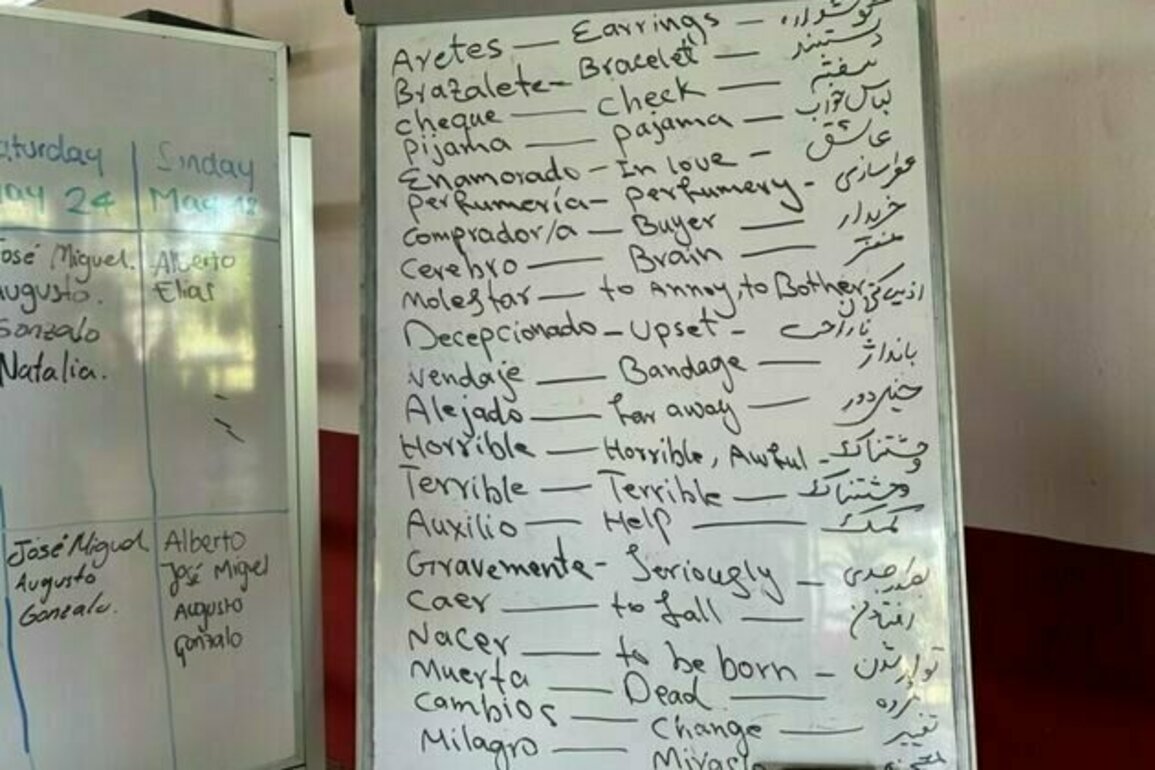
At the shelter, Hatim doesn't lose hope, as he uses the Fe y Alegria's whiteboard to teach his fellow migrants Spanish words. One morning last week, he wrote the translations for "worship," "praying" and "nightmare."
The emergency shelter on the outskirts of Panama City was set up after the migrants, and dozens of others, were left stranded there following their deportation from the United States. Before that, they had been held incommunicado, first in a city hotel and later in a migrant camp in San Vicente, near the Colombian border.
Fe y Alegria is part of the CLAMOR network, a web of religious institutions that provide aid and advocate for migrants, refugees and victims of human trafficking living in displacement. When Father Marco Gomez, who runs the organization, heard about the deportations, he decided to reconfigure their sports court to welcome four dozen migrants, as those with families moved to hotels provided by UNICEF.
The deportees never intended to stay in Panama, but the place carried weight. For those coming from the south, Panama marks the end of the Darien Gap, the only land route between South and Central America, and the conclusion of one of the most dangerous legs of the migration journey.
"We saw no one else was helping," Gomez said. "They don't speak Spanish, and they barely speak English." Gomez saw men, women and kids from faraway lands. "We figured we had to open our doors for them."
Those at Fe y Alegria were all suddenly expelled from the U.S. alongside 200 others between February 12 and 15. According to Human Rights Watch, the incident occurred after the migrants were denied access to fair asylum procedures, as guaranteed by law, and were not given information or documentation explaining their deportation orders.
In his quest to live up to his campaign promise of mass deportations and closed borders, U.S. President Donald Trump has chosen controversial locations for deportation, including Guantanamo Bay, El Salvador President Nayib Bukele's maximum security prison, a Costa Rican migrant camp and Panama. His complex immigration policy, often based on transactional diplomacy, has left hundreds of thousands of migrants in precarious situations. They not only face uncertainty about their future but also the danger of being deported back to the very countries they escaped from for their safety.
The negotiations between the Jose Ral Mulino and Trump administrations to allow the deportation of 300 men, women and children from Africa and Asia to Panama are still unknown. After an immigration lawyer filed a precautionary lawsuit before the Inter-American Court of Human Rights to prevent the migrants' expulsion, Mulino's government responded by granting them 90-day temporary permits, with no right to work, leaving them effectively paralyzed as they wait for another country to accept them. With passports from countries like Iran and Afghanistan that are often unusable, their futures now rest in the hands of foreign politicians.
"Where is Panama?" asked Artemis Ghasemzadeh, a 26-year-old Iranian woman who fled her country with her brother after converting to Catholicism, an act considered a crime against national security in Iran. After realizing that a six-hour flight was too long for an interstate transfer from one detention center to another, she approached an officer on the plane to ask where they were going. When they told her, she broke down in tears. The rest of the deportees asked what had happened.
"Nothing, I'm sad because it's my birthday," she replied. It was true.
Ghasemzadeh, like the rest, had spent days under ICE detention after crossing the U.S.-Mexico border seeking political asylum. Everyone has their reasons: political persecution, murder of family members and friends, religious persecution, gender-related issues and escaping war zones. All of them, with no exception, had crossed half of the world in often dangerous conditions to reach the border and turn themselves in to U.S. authorities.
Aside from Ghasemzadeh, no one else was told where they were being taken - they only knew once they landed in the humid night of Central America. Despite the efforts of the organizations that advocated for their safety and provided them with housing, Panama City still felt like an odd place, from its weather to its food and culture. A Russian man told Courthouse News that, having been born in Moscow, he felt overwhelmed by the heat. Iranian women said they lacked the ingredients to cook the meals they usually eat. Lunch and dinner at the shelter primarily consist of rice or pasta.
They built efforts to go out in groups around the city. Still, they were scared of being in a foreign Latin American country because of the things they had seen on the migrant trail, including criminal organizations, extortion and kidnappings.
"Panama allowed them to enter the country but didn't provide humanitarian aid or permanent permits," said Caitlyn Yates, an anthropologist who researches migration and security policy projects in Panama. "And the fact that the terms of their arrangements with the U.S. government remain undisclosed makes it hard to dispute this in court."
Yates, alongside several independent experts and watchdog organizations, has been assisting the deportees since they arrived in Panama and is working to find more sustainable options to rebuild their lives. Their top priority now is finding a place willing to take them before their Panama permits expire on June 7.

And Panama, a nation with a population of 4.4 million and a migrant population of less than 4%, has been a territory of uncertainty and concern for months. Out of the almost 300 deported, over 180 have fled to other countries (or their own) after being released from Panamanian authorities on March 11. But several others, such as those at Fe y Alegria, exhausted their resources and took on debt to reach the U.S. border in the first place.
With the Panamanian government withholding work permits, at least for now, the migrants are unable to move forward. Panamanian law does not establish a specific deadline for responding to refugee applications. According to the United Nations High Commissioner for Refugees, it can take more than three years. And if their temporary permits expire and the governments involved don't take action to protect their lives, men, women and dozens of children could face another deportation.
Organizations and independent advocates have urged the Mulino government to extend the permits and have also attempted to secure relocation to a "third safe country," which, for these migrants, would now be a fourth; however, negotiations have repeatedly stalled.
"All of this time, we wanted to go to the United States," said Nuria, a 26-year-old Afghan. She fled to Brazil eight months ago and traveled by land across the Americas to reach the U.S.-Mexico border. "But we didn't expect to be deported - I don't think good things can happen for us there anymore."
However, one thing is clear: returning to Afghanistan is not an option. "I don't have a hijab," she said. "They will kill us, they will send us to jail straight from the airport."
Every day, women like Artemis Ghasemzadeh and Nuria wake up awaiting word on their fate, whether Panama will extend their permits or another country will agree to take them in. In the meantime, they share their stories in hopes of dissuading the U.S. government from carrying out arbitrary deportations that could place others in the same desperate situation.
"We've come from a long way," Ghasemzadeh said. "And sharing our stories in the news might not help us at this point, but they could help others. We cannot go back. This is a matter of survival."
Source: Courthouse News Service